
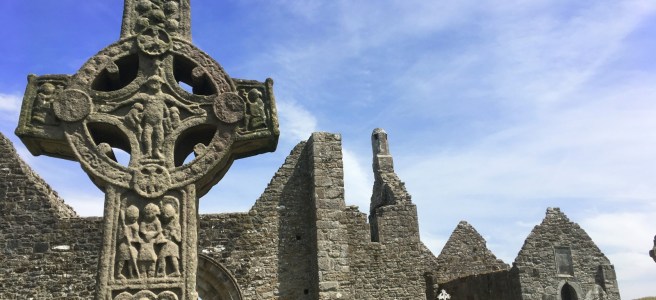
In the rolling heart of Ireland’s midlands lies Clonmacnoise (pronounced “Clon-mac-noyce”), one of the most sacred monastic sites in all of Ireland. Nestled along the River Shannon in County Offaly, Clonmacnoise is home to some of the most famous Celtic Crosses in the world, each intricately carved with biblical stories, Celtic patterns, and ancient Irish artistry. These crosses are not only symbols of Ireland’s spiritual heritage but also powerful works of medieval art that continue to inspire visitors and craftspeople today.
Among them, the Cross of the Scriptures stands tall as one of the finest surviving examples of a Celtic High Cross in Ireland. For centuries, it has captured the imagination of pilgrims, historians, and artists alike and today, it even inspires modern jewelry design, such as the Cross of the Scriptures Necklace.
What is the Clonmacnoise Cross?
When people refer to the “Clonmacnoise Cross,” they usually mean the Cross of the Scriptures, the most celebrated of Clonmacnoise’s high crosses. Standing at nearly 13 feet tall, this sandstone masterpiece dates back to the early 10th century. Its carvings tell biblical stories in a way that monks and laypeople alike could understand a kind of medieval “illustrated Bible” in stone.
Unlike simpler grave markers, Celtic High Crosses like those at Clonmacnoise served a higher purpose. They were both teaching tools and public displays of faith. The Cross of the Scriptures depicts scenes such as:
- The Crucifixion of Christ
- The Last Judgment
- The Arrest of Christ
- Other Gospel-inspired images
These carvings brought Scripture to life for a largely illiterate population, reinforcing the teachings of the monastery. To stand before the cross even today is to witness Ireland’s history carved into stone.
What is the Most Famous Celtic Cross?
Ireland is dotted with hundreds of Celtic High Crosses, but the Cross of the Scriptures at Clonmacnoise is widely considered one of the most famous. Historians often cite it as the finest example of early medieval stonework. Its detailed panels and iconic ringed cross shape are so influential that countless replicas have been made across Ireland and beyond.
In fact, when you think of the classic Celtic Cross shape, a tall cross with a circle connecting its arms, you’re picturing the style perfected at Clonmacnoise.
The fame of the site is enhanced by its location: perched on the River Shannon, Clonmacnoise was a hub of religion, trade, and scholarship for over a thousand years. Kings and nobles sought burial here, making the crosses not just symbols of faith but also monuments of status and memory.
What is the Significance of Clonmacnoise?
Clonmacnoise is far more than a collection of ruins; it is one of Ireland’s most historically and spiritually significant sites. Founded in the mid-6th century by St. Ciarán of Clonmacnoise, the monastery quickly became one of the great centers of learning and religion in early Christian Ireland.
For centuries, Clonmacnoise was a crossroads where faith, culture, and politics met:
- A Monastic University: Scholars from across Europe studied here, copying manuscripts, producing metalwork, and creating illuminated texts.
- A Royal Burial Site: Kings of Tara and Connacht were buried here, giving it immense political prestige.
- An Artistic Beacon: The site’s round towers, churches, and Celtic crosses influenced architecture and art throughout Ireland.
Today, Clonmacnoise remains one of the most visited heritage sites in Ireland. Its crumbling churches, round towers, and Celtic crosses stand as a testament to Ireland’s early Christian Golden Age.
What Saint is Associated with Clonmacnoise?
The saint most closely associated with Clonmacnoise is St. Ciarán (Ciarán mac an tSaeir). Born around 516 AD in County Roscommon, he was the son of a carpenter and trained under St. Finnian at Clonard before founding his own monastery at Clonmacnoise.
Although St. Ciarán died at a young age, likely around 33, his influence was profound. His monastery thrived long after his death, becoming one of Ireland’s most enduring centers of Christian learning. Today, pilgrims still come to Clonmacnoise to honor his memory.
The Three Great Crosses of Clonmacnoise
While the Cross of the Scriptures is the most famous, Clonmacnoise boasts three monumental high crosses, each with its own story:
1. The Cross of the Scriptures
- Dates: 10th century
- Material: Sandstone
- Features: Carved biblical panels, inscriptions mentioning kings and abbots
- Significance: Considered the finest surviving high cross in Ireland
2. The North Cross
- Dates: Likely 8th or 9th century
- Features: One of the earliest examples of a ringed cross in Ireland
- Style: Heavily influenced by metalwork, with interlacing designs and abstract patterns
- Condition: Only the shaft survives, but its carvings show an evolution in cross design
3. The South Cross
- Dates: 9th century
- Features: Sometimes called the “Cross of Patrick and Columba”
- Design: Bold, abstract carvings rather than detailed figural scenes
- Significance: Symbolically connects Ireland’s two most famous saints, St. Patrick and St. Columba
Together, these crosses show the progression of Irish stone carving from simple abstract designs to fully realized biblical storytelling.
Celtic Cross Symbolism at Clonmacnoise
The Celtic Cross itself is rich with symbolism. Its circle, connecting the arms of the cross, is said to represent eternity, the sun, or the unity of heaven and earth. At Clonmacnoise, the crosses combine Christian faith with older Celtic motifs, creating a uniquely Irish form of devotion.
This fusion of cultures is why the Celtic Cross remains one of the most enduring symbols of Ireland today. It speaks not only to faith but also to heritage and identity.
Clonmacnoise in the Modern World
Visiting Clonmacnoise today feels like stepping back in time. The crosses stand weathered but proud, protected by replicas placed outdoors, while the originals are preserved in a visitor center. Pilgrims and tourists alike are drawn to the site’s quiet majesty, often leaving with a deeper appreciation of Ireland’s spiritual and artistic past.
And yet, the crosses’ influence continues far beyond the monastery walls. From Irish cemeteries to jewelry designs, the Celtic Cross remains a beloved emblem.
From Stone to Jewelry: The Cross of the Scriptures Necklace
At The Irish Jewelry Company, the Cross of the Scriptures Necklace captures the timeless beauty of Clonmacnoise’s most famous high cross in miniature form. Crafted with intricate detail, this piece allows you to carry a part of Ireland’s sacred history with you.
Just as the monks carved biblical stories into stone, modern jewelers translate those same designs into precious metals, creating wearable reminders of faith, heritage, and artistry. For many, owning such a necklace is not only about beauty but also about a spiritual connection to Ireland’s past.
FAQs About Clonmacnoise and Its Crosses
What is the Clonmacnoise Cross?
The Clonmacnoise Cross, also known as the Cross of the Scriptures, is a 10th-century high cross covered in biblical carvings. It stands as one of the most famous Celtic Crosses in Ireland.
What is the most famous Celtic Cross?
The Cross of the Scriptures at Clonmacnoise is widely considered the most famous and finest surviving Celtic High Cross.
What is the significance of Clonmacnoise?
Clonmacnoise was a major center of religion, learning, and politics in medieval Ireland, known for its monastery, royal burials, and artistic achievements.
What saint is associated with Clonmacnoise?
Clonmacnoise was founded by St. Ciarán, who is venerated as its patron and spiritual father.
Conclusion: The Enduring Legacy of Clonmacnoise
The Celtic Crosses of Clonmacnoise are more than ancient stone monuments; they are timeless symbols of Ireland’s faith, artistry, and cultural identity. From the Cross of the Scriptures to the simpler South and North Crosses, they embody a unique blend of Christian devotion and Celtic creativity.
To stand before them is to step into a story that spans over a thousand years. And today, thanks to modern artisans, you don’t need to travel to County Offaly to bring that story home. The Cross of the Scriptures Necklace allows you to wear a piece of Ireland’s sacred history close to your heart, carrying forward the legacy of Clonmacnoise into the present day.

 irish culture and traditions