The sapphire, which is also known as the September birthstone, is a prized jewel that dates back thousands of years. Despite the fact that the word “sapphire” most often refers to the blue version of the mineral corundum, the sapphire birthstone is available in a wide range of other hues as well. Sapphires are thought to represent faithfulness and the soul, in addition to their long-standing association with the monarchy and the romantic pursuit of a partner.
Where did the word Sapphire originate?
The name sapphire originates from the Greek word “sappheiros,” and blue sapphire is considered to be one of the most desirable colored stones. Continue reading to discover more information about the September birthstone, including its history and the locations where it may be discovered.
September Birthstone Meaning
Sincerity, honesty, fidelity, and nobility have all been historically associated with the September birthstone, the sapphire. Sapphires have been prized for their beauty and durability for countless years, making them a popular choice for royal and religious adornment. Ancient Greece and Rome’s upper classes had the belief that blue sapphires provided their owners with protection from injury and jealousy. Sapphires were worn by clerics throughout the Middle Ages because they were thought to represent heaven. The ancient Persians thought that the blue color of the sky was caused by a great sapphire that the planet truly lay on.
In addition, it was believed that the September birthstone has curative properties. People in medieval Europe thought that eye ailments and boils caused by the plague might be treated by sapphire. It was formerly believed that the sapphire birthstone has the ability to reverse the effects of poison.
A Brief History of the Sapphire
In the year 1881, a landslide high in the Himalayas uncovered a vast pocket of velvety “cornflower” blue crystals, which led to the discovery of sapphires in the region of Kashmir. The Maharaja of Kashmir and his troops grabbed possession of the new region as soon as they discovered stunning sapphire deposits farther south. These deposits were found in the region. Between the years 1882 and 1887, tens of thousands of massive and exquisite crystals were unearthed. The reputation of Kashmir sapphire as one of the most sought-after gems in the world was created by the stones that were faceted from these crystals. Since then, production has been irregular, although auction houses still sometimes offer high-quality items of jewelry made from Kashmir sapphire.
Where are Sapphires found?
Kashmir, Myanmar (also known as Burma), and Sri Lanka are three historically significant sources for the September birthstone, the sapphire. Sapphires are found in all three of these locations. In addition to various nations in Asia and Africa, significant amounts of the gemstone associated with the month of September have been discovered in Australia, Thailand, Cambodia, Madagascar, and the state of Montana in the United States.
Famous Sapphires in Jewelry
One of the most well-known examples of a sapphire is the Rockefeller Sapphire, which is a 62.02-carat rectangular step-cut stone that was discovered in Myanmar (Burma). The stone was recut and remounted over the years after being purchased from an Indian maharaja in 1934 by John D. Rockefeller, Jr. (1874–1960), a banker and philanthropist in the United States. The sapphire was first mounted as a brooch, but it was eventually fashioned into a ring with two cut-cornered triangular diamond side stones. The blue stone weighing 12 carats that are encircled by diamonds in the sapphire engagement ring that was originally owned by Princess Diana and then passed down to Kate Middleton, who is now known as the Duchess of Cambridge, is perhaps the sapphire that has gained the most notoriety in recent years.
SAPPHIRE BIRTHSTONE CARE & CLEANING
The Mohs hardness scale places the sapphire, which is the September birthstone, with a value of 9. It has a high resistance to breaking and is devoid of cleavage, which is the propensity to crack when it is hit. Because of this, it is an excellent option for rings and other mountings that are susceptible to day-to-day use.
It is important to keep in mind, however, that sapphires are often treated in order to increase their color or clarity. Because heat treatment is so prevalent – and because the effects it produces are long-lasting – it is widely recognized in the industry. Treatments that are not as prevalent, such as lattice diffusion, fracture filling, and dyeing, may have specific requirements that must be met. Because the color that is produced by lattice diffusion is often quite superficial, it is possible that it may be removed from the stone if it were chipped or if it needed to be recut. Even weak acids like lemon juice are strong enough to destroy sapphires that have been fracture-filled or colored. Always inquire about whether or not a sapphire has been treated, as well as the process that was used.
When it comes to cleaning the September birthstone, the tried-and-true method of using warm water with a little bit of soap is your best bet. In most cases, untreated, heat-treated, and lattice diffusion–treated stones may be cleaned using ultrasonic and steam cleaning equipment without risk. Only a moist cloth should be used to clean material that has been colored or filled with fractures.
The culture and people of Ireland have had a significant impact on our selection of September Birthstone Jewelry. Available in a number of different designs, including the Claddagh and other Irish symbols. Earrings, rings, pendants, and bracelets are all included in the designs. Pick out a beautiful piece of sterling silver or gold jewelry with a September birthstone in it. Ireland is the source of inspiration for each painting. The month of September’s birthstone is the sapphire.
The Celtic festival known as Mabon takes place on the Autumn Equinox. Mea’n Fo’mhair is the name that the Druids give to this festival, during which they pay homage to the Green Man, who is considered to be the God of the Forest, by pouring libations for the trees. At this time, it is permissible to make offerings of ciders and wines, as well as herbs and fertilizer. Mabon, like Ostara, is an equinox festival, but unlike Ostara, the emphasis of Mabon is on balance. This is because the vernal equinox is one of the few occasions throughout the year when genuine balance can be seen in nature. Day and night are on par with one another. At Mabon, the chopping down of John Barleycorn is symbolized by the use of three stalks of locally gathered barley that are knotted together with rafia and a little bit of red wool. The folk tale and song known as “The Ritual of John Barleycorn” is meant to symbolize the planting, growth, and final “sacrifice” or harvesting of corn. The story is told in the form of a ritual. Mabon is known as a period when mysteries may be revealed. It is appropriate to pay homage to the Spirit World at this time. It is a time that is considered to be a time of equilibrium, and it is during this time that we take a break, relax, and take pleasure in what we have produced as a result of our individual labors, whether those labors have been directed toward the care of our gardens, our families, or any projects that we have been working on.
After the toil and labor of harvesting, the festival of Mabon ushers in a period of leisure and relaxation. In terms of one’s life path, it is the season of reaping what one has sown; it is the time to look back at the goals and ambitions of Imbolc and Ostara and reflect on how those hopes and aspirations have come to fruition. As we get ready to start our descent, now is the time to wrap up any unfinished business, clean house, and let go of everything that is no longer desired or required so that we may make the most of the quiet and reflective season that winter brings. And now is the moment to sow the seeds of fresh thoughts and dreams, which will remain dormant but be nurtured in the darkness until the coming of spring.
About the Autumn Equinox also known as Mabon
How do you pronounce Mabon?
The word Mabon is pronounced MA-bun with the “a” like in cat. It is a modern word to describe the Fall Equinox.
What is the Meaning of Mabon?
The name “Mabon” comes from the sun deity of the same name who was worshiped in the Celtic religion. Mabon, also known as the Fall or Autumn Equinox, is also known as the Festival of Dionysus, the Harvest of First Fruits, and the Wine Harvest.
What is the celebration of Mabon?
The Autumnal Equinox marks the beginning of Mabon, a pagan harvest festival that is held annually around September 21st and continues until September 24th. This celebration, which is also known as Harvest Home, takes place in the midst of the harvest season, at the point in time when the days and nights are of equal duration. Pagans and ancient Celts observed this day as a time to express gratitude to the natural world for a bountiful harvest and to pray to their deities and goddesses for the continuation of the harvest during the colder months.
What exactly is the story of John Barleycorn?
John Barleycorn is a figure that appears in English mythology. He is said to personify the harvest of barley that takes place in the fall. In addition to this, he is symbolic of the magnificent beers and whiskeys that can be produced from barley, as well as the benefits that these beverages have.
What is the term given by the Celts to the Autumn Equinox?
Mabon is the name of the Celtic festival that celebrates the autumn equinox and takes place when the summer heat gives way to the crisp air of autumn. This event is held every year as a part of the traditional Celtic festivals, which trace back to ancient times.
What is the Autumn Equinox?
The autumnal equinox, when the Sun travels south over the celestial equator, occurs on September 21 or September 23 in the Northern Hemisphere. As the Sun crosses the celestial equator heading northward on March 20 or 21, the Southern Hemisphere experiences the equinox. Peasants in Christianized parts of Europe observed the autumn equinox as the Feast of the Archangel Michael throughout the Middle Ages.
When Exactly does the Autumn Equinox take place?
What exactly is the equinox that occurs in autumn? The sun is aligned such that it shines squarely on the equator at the fall equinox, and this ensures that both the northern and southern hemispheres get an equal quantity of sunlight. At exactly 2:21 p.m. on Wednesday, the alignment will take place formally. Regardless of whether or not there are clouds in the sky, Austin will get around 12 hours and 8 minutes of daylight.
In Celtic mythology, Mabon is the period when, according to folklore, the God of Light was vanquished by the God of Darkness, which resulted in the lengthening of the night. Mabon is the son of Modron, the Great Goddess of the Earth, according to Celtic tradition. After his birth, Mabon was abducted for three days, which caused light to go into hiding. In addition, Mabon represents the masculine character that is associated with the harvest.
The symbols we identify with Thanksgiving are very similar to those associated with Mabon symbols.
Apples: The apple is used to represent the Fruit Harvest as a symbol. In a great number of spiritual practices, the apple plays a crucial role. It is a symbol of healing, rejuvenation, regeneration, and completeness in addition to representing life and immortality. It is said to restore youth, add years to your life, and make you more beautiful. The apple is known in Ogham as “Quert,” which is also the name of a character who exemplifies health and energy. The apple, which represents the origin of life, may be found in the center of the Ogham grove. The pagan belief is that the apple harbors a “secret.” If you cut an apple lengthwise, you will find that it has the shape of a pentagram and contains five seeds. It is a beloved representation of the Pagan religion. As a result, the five points also symbolize the cardinal directions of east, south, west, north, and inside in addition to the elements of earth, air, fire, and water, with spirit at the top of the list.
The Cornucopia: Mabon is traditionally represented by the cornucopia, also known as the Horn of Plenty. It is a magnificent sign of the prosperity that harvest brings, and it is a beautifully balanced symbol that has both masculine (phallic) and feminine elements (hollow and receptive).
The colors of autumn foliage are the ones most often associated with the Mabon Celebration, so this shouldn’t come as much of a surprise.
dark green
red
orange
yellow
brown
gold
The Autumn Equinox and Mabon is a time of celebration as well as leisure after the toil and labor of the harvest. In terms of one’s life path, it is the season of reaping what one has sown; it is the time to look back at the goals and ambitions of Imbolc and Ostara and reflect on how those hopes and aspirations have come to fruition. As we get ready to start our descent, now is the time to wrap up any unfinished business, clean house, and let go of everything that is no longer desired or required so that we may make the most of the quiet and reflective season that winter brings. And now is the moment to sow the seeds of fresh thoughts and dreams, which will remain dormant but be nurtured in the darkness until the coming of spring.
According to Oxford Languages the literal definition of Celtic is is relating to the Celts or their languages, which constitute a branch of the Indo-European family and include Irish, Scottish Gaelic, Welsh, Breton, Manx, Cornish, and several extinct pre-Roman languages such as Gaulish.
The Celts were a group of people who had their roots in the center region of Europe. They were characterized by their common culture, customs, language, and religious beliefs. It is generally agreed upon that the Celtic civilization began to develop sometime around 1200 B.C. Migration allowed the Celts to establish a presence over most of western Europe, including Britain, Ireland, France, and Spain. Their Celtic heritage is best preserved in Ireland and Great Britain, where remnants of their language and culture may be found even in modern times.
Even though they are not strictly considered to be of Celtic origin, the Vikings had many characteristics in common with the Celts. The Celts and the Vikings were two distinct people groupings, notwithstanding the possibility that the Celts had some indirect impact on the Vikings. In the year 1000 BC, the two tribes lived in close proximity to one another and competed with one another.
The religion of the Celts was polytheistic, and its adherents believed in a great number of gods and goddesses. Some of these deities were worshiped solely in a specific location or region, or by a single tribe, whilst the worship of other deities was more widely practiced across the Celtic world.
The term “Celtic” conjures up images of the traditional art, literature, and music of Ireland and Scotland when heard by contemporary ears. However, the ancient Celts were a dispersed ethnic group that had its roots in the center region of Europe. Take a look at what historians have discovered about this diverse and intricate assemblage of different tribes.
What qualities distinguish a person as Celtic?
The term Celtic is used to refer to persons who trace their ancestry back to one of the present Celtic territories located in the westernmost parts of Europe. Through the ages, each of these places has managed to preserve a significant portion of its original culture as well as its particular language.
Since the time of the Enlightenment, the word Celtic has been used to refer to a diverse range of peoples as well as cultural characteristics from the past and the present. Today, inhabitants of Celtic countries (the Bretons, the Cornish, the Irish, the Manx, the Scots, and the Welsh) and their separate cultures and languages are often referred to as Celtic, and the term “Celtic” is frequently used to characterize them.
The ancient Celtic people were renowned across the world for their vibrant wool fabrics, which were the ancestors of the well-known Scottish tartan. Historians think that the Celtic people were one of the earliest people in Europe to wear trousers, despite the fact that only a few tantalizing shreds of these fabrics have survived the years.
The word is often pronounced “Keltik” by those who are knowledgeable in Celtic history, language, and culture; nevertheless, sports fans call it “Seltik.”
The letter ‘C’ is usually pronounced “kuh” in Irish, Scottish, and Welch, among other Celtic languages; yet, the word Celtic is spoken with a strong ‘C’ sound.
What is Celtic Jewelry?
It is believed that the beginnings of Celtic jewelry stretch back to between the years 2000 BC and roughly 550 AD, during which time silver and gold were employed by Celtic artisans to produce wonderful jewelry that was embellished with Celtic motifs.
Although time has passed and the process of making Celtic jewelry has been refined, the representation and meanings of the ancient Celtic symbols remain prominent in the decoration of modern-day pieces. This means that while the styles may have changed, what remains very much evident is the significance. This is one of the reasons why charming and symbolic Irish Celtic Jewelry is so highly sought after and admired throughout the world.
Celtic rings, Celtic bracelets, Celtic pendants, Celtic earrings, Celtic brooches, Celtic charms, and a great deal more are all part of the delightful selection of Celtic jewelry that is currently on the market and offered by The Irish Jewelry Company. Celtic jewelry makes the ideal Irish gift because it is unique in its meaning, style, and its splendor.
The stunning Celtic term “Anam Cara” may be roughly translated as “Soulmate,” and it refers to a person’s soul mate. ‘Anam’ is the Irish Gaelic term for soul, and ‘cara’ is the translation of the word for friend in Irish (Gaelic). The phrase “soul friend” comes directly from the translation. It does not just depict the coming together of two souls; rather, it expresses a connection that is highly particular and unique between two individuals. In contrast to the more generic idea of a soulmate, the term “Anam Cara” refers to a specific kind of connection that may either be platonic or romantic. They might be a romantic partner, a close friend, a member of your family, or even a spiritual mentor.
Anam Cara is a concept that encompasses much more than the straightforward concept of a close friendship. It is a central tenet of Celtic thought and Irish folklore that any two souls who share this extraordinary bond will become more powerful as a unit than they could ever be as individuals. According to the beliefs of the Celts, your Anam Cara or soulmate may take the form of a friend, a companion, or a spiritual advisor. In the end, everyone, either consciously or on a level that was more subconscious to them, aspired to discover their real lifelong best friend.
You can never be entirely whole if you do not own an Anam Cara. The proverb “A person without an Anam Cara is like a body without a head” is attributed to Saint Bridget, who is one of Ireland’s few female patron saints. Once missionaries from mainland Europe arrived on the island of Ireland (about the 6th century), it is believed that the custom and idea of Anam Cara transitioned from Celtic rituals to Christianity. This occurred throughout the time period.
Despite the fact that the Celts had a distinct and well-developed notion of souls and soulmates in the form of the Anam Cara, the idea did not originate with them. There is not a lot of information available on its origin. Plato, an ancient Greek philosopher, is credited with making the first reference to it. In his philosophical work titled “The Symposium,” which was written around the year 380 BC, he lays forth an equally fascinating notion. This idea is a little bit more out there than others.
Plato had a view of human nature that was distinct from how modern people like you and I may see it. Plato postulated that there are not two but three genders: male, female, and male-female.
The third gender had a spherical appearance. It consisted of a back and sides that came together to create a circular. There were four hands, feet, and ears, and the two faces stared in opposite directions from each other. Back to back, there was a guy and a girl in this situation. If it wanted to travel quickly, it could either walk upright or do a cartwheel. In all candor, we are not making any of this up! Plato had a very particular point of view.
The sun was the first source of man. The ground is where women originated. The man-woman hybrid once inhabited the moon. Plato believed that the sun and the earth came together to form the moon. The androgynous gender had a powerful, penetrating energy, and was known to be very passionate. Additionally, they had a significant mind. They scaled the heavenly barriers in an effort to get closer to the gods and launch an assault. The gods were thrown into chaos, and they argued among themselves about the best way to go forward.
Some people thought that they should use lightning to kill all of the men and women, just as they had done with the giants. However, Zeus proposed that the men and women should be separated into two groups. They would then experience a decrease in strength while simultaneously experiencing an increase in numbers. If they persisted in disobeying him, he would chop them in half once again – “so they will hop about on a single leg,” he would say.
The concept of spirituality and the merging of two souls lies at the heart of Anam Cara. There are certain parallels that can be seen between the concept of soul mates in different civilizations. The idea that every soul has been linked to every other soul from the beginning of time is a common one. When you finally meet your anam cara, it is as if two souls have merged into one, and from that point on, you will never forget each other.
The idea of “Anam Cara” may be applied to any culture. The idea is both understandable and widely acknowledged in today’s society. The Celts, much like other ancient civilizations all throughout the globe, recognized the significance of healthy relationships and the necessity of discovering connections that are both profound and long-lasting to our mental and spiritual well-being.
Mo Anam Cara Jewelry
Anam Cara jewelry is usually Irish jewelry or Celtic jewelry that features the phrase Anam Cara or Mo Anam Cara. Mo anam cara (moh anum cair-ah) – my soulmate. This phrase means “My Soul Mate” or “My Soul Friend.” The ancient Celts thought there was a soul that spread out over the body. When two people formed a strong bond, their souls would mix and each person could be called their “anam cara,” or “soul friend.” This beautiful phrase was the source of The Irish Jewelry Company’s huge selection of Mo Anam Cara Jewelry.
The habit of prefixing the family name with O’ or Mac is one of the most identifying characteristics of Irish surnames. This is also one of the most common prefixes.
Hereditary surnames were introduced in Ireland at an early date, making it one of the pioneering nations in this regard. It is thought that many of these were developed during the time of Brian Boru, who was the High King of Ireland. They are used to this very day in many different contexts.
Is Mac of Irish or Scottish ancestry?
Mac and Mc are interchangeable in a grammatical sense; there is no distinction between the two. It seems that the contraction of Mac to Mc has been more common in Ireland than it has been in Scotland, with two out of every three Mc surnames having their roots in Ireland, whereas two out of every three Mac surnames have their roots in Scotland.
The origin of Irish family names may be traced back to the use of patronyms, which were titles given to a son or grandson by their fathers. This is the reason why these prefixes were first implemented in the first place. The prefix “Mac” has its roots in the Irish language, which is why so many Irish surnames begin with it.
For grammar purposes, there is no difference between Mac and Mc; both are acceptable. Two out of every three Mc surnames can be traced back to Ireland, but the same cannot be said for Mac surnames.
In the top ten most common surnames in Ireland, McCarthy is the sole Mac or Mc name, whereas MacDonald is the only one in the top ten most common surnames in Scotland.
Why do Irish surnames have MC?
The name Mac, which is sometimes shortened to Mc, derives from the Irish word for son, which is a mac. Mock is how it should be pronounced. This was appended to the beginning of the parent’s name or trade in order to distinguish a father from a son.
For instance, the name “MacDonald” translates to “the Son of Donald” when spoken in Irish. This is also observed in many other popular Irish surnames, such as McEneany, where the Mac is often abbreviated to Mc.
Mc vs Mac Catholic or Protestant
The common misconceptions that Mc is a prefix that is uniquely associated with Ireland, while Mac is a prefix that is only used in Scotland, and that families who practice Catholicism use one prefix while families who practice Protestantism use the other prefix are both incorrect. In point of fact, the same person’s surname was often recorded using both Mac and Mc on various occasions. This occurred rather frequently.
In honor of President’s Day let’s discuss several American Presidents who claim Scottish and Irish descent. Many people of Irish descent have been known to migrate away from their country for many generations in search of better job prospects and life experiences in other cities, nations, and continents. Following a number of years of traveling, others find their way back home. Some people move away from their home country and start a new life there. Some Irish Americans are elected to the Office of President of the United States!
An astounding 23 of the 46 people who have held the office of President of the United States of America have claimed Irish ancestry, ranging from 7 times great grandparents to direct descendants of immigrants. That’s right nearly half of the US’s presidents claim to be Irish American Presidents. Although none of them were born in Ireland (and even if they were, they wouldn’t be eligible for the presidency of the United States), several have been there to see where their ancestors originated from. In their hometown, they have been greeted by large groups of well-wishers and, on occasion, offered a free pint.
A good number of these Irish-American individuals went on to play significant roles in the course of history and are recognized all over the globe for the accomplishments they made while in office. The following is a list of 13 of the 23 Irish Americans who have served as President of the United States, along with the history of their forebears and the path that led them to assume one of the most influential posts in the world.
President Andrew Jackson
Andrew Jackson was the first President of the United States to claim Irish heritage. He served as the 7th President of the United States. From 1829 to 1837, he served in that capacity. His parents had arrived in America just two years earlier, in 1765, from Ireland, together with their two other boys who were also born in Ireland. He was born in 1767 at the border area of North and South Carolina. Unfortunately, Jackson was never able to meet his father. His father passed away at the age of 29, just a few weeks before his son was born. During the American Revolutionary War, he served as a messenger while he was only a little lad. After that, he went on to become a lawyer and ended up playing a role in the establishment of the state of Tennessee. In addition, before being nominated for the presidency in 1822, he served for a while in the Tennessee militia. In spite of the fact that he failed to win the election the first time around, he did it successfully in 1828 and is mostly renowned for the inhumane Indian Removal Policy, which expelled Native Americans from the land that was rightfully theirs.
President James Knox Polk
James Knox Polk, who was born in 1795 and served as President of the United States from 1845 to 1849, was the 11th President of the United States. His family was one of the earliest European pioneers to come to the United States, and he was one of ten children. His family was of Scottish and Irish heritage. Polk was 49 years old when he took office as President of the United States, making him the youngest person to ever hold that position. He made a solemn oath to serve in that capacity for no more than one term, and he was successful in achieving all of the objectives he had established for himself at the outset of that term: to re-establish the Independent Treasury System, to reduce tariffs, and to acquire Oregon Country, California, and New Mexico (the latter of which actually involved invading Mexico and fighting a war with them!). He also kept his promise to step down from office at the end of that However, his constant effort took its toll on his health, and just a few short months after completing his tenure, he passed away from cholera.
President James Buchanan
James Buchanan was another American president of Scots-Irish ancestry; more particularly, his ancestors on both sides were of Ulster-Scots heritage. James and his 10 siblings were brought up in Pennsylvania by their father, who moved there in 1783 after leaving Donegal. After that, Buchanan went on to achieve a great deal of success in politics, ultimately becoming Secretary of State. The majority of people were not impressed by him during his time in office from 1857 to 1861, and he is mostly recognized for passing up a great number of significant changes that were subsequently used by his successor, Abraham Lincoln. As a result of his seeming lack of interest in his fiancé, many people assumed that he was homosexual since he chose to immerse himself in his career rather than in his relationship. She called off the engagement, and not long after that, she passed away from what seems to have been hysteria brought on by an overdose of laudanum (a kind of opium).
President Ulysses S. Grant
An Irishman by the name of John Simpson, who was originally from County Tyrone, was Ulysses S. Grant’s great-great-grandfather. Despite the fact that both of Grant’s parents were members of the Methodist church, he was never baptized and never joined any specific religious denomination. This was quite unusual for early inhabitants of the area. In spite of the fact that he was given the name Hiram Ulysses at birth, when he registered for the United States Military Academy, his name was entered incorrectly, and from that point on, he was known as Ulysses S. Grant. Grant was not interested in pursuing a career in the military, so he resigned after completing the required number of years of duty. However, he had a difficult time finding work in another field and ended up rejoining the Union Army during the Civil War. During the years 1869–1877, while he served as president, he advocated, among other things, for a peace process with Native Americans and civil rights for formerly enslaved people who had been released. After completing his second term as president, Grant became the first Irish American president to go to the home of his ancestors. This trip took place in 1878. Grant went to see the home of his great grandpa in Tyrone, which is now an exhibition center devoted to telling the narrative of Grant’s life.
President William McKinley
William McKinley, the 25th President of the United States, was a descendent of an Irish farmer who lived in Conagher, which is located in County Antrim. McKinley was so proud of his Irish ancestry that he even spoke at a national Scots-Irish conference that was held in the late 19th century. He is credited with rapid economic success during his term of office from 1897–1901, but unfortunately, his contributions to America and the rest of the world were cut short when he was assassinated by a man hiding his gun under a tissue during a meet and greet with the public. This tragic event cut short his time to make a positive impact on America and the rest of the world.
President Theodore Roosevelt
Theodore Roosevelt, who served as president of the United States during the 20th century, has Irish ancestry on his mother’s side. He is considered to be one of the most famous figures of that era. In 1729, her ancestors left Glencoe, which was located in County Antrim, and moved to the United States. Roosevelt is famous for having said that Irish Presbyterians, who belonged to the religion that his mother practiced, were a “brave and sturdy people.” As a youth, Roosevelt struggled with severe asthma, and he later lost both his wife and mother within the span of twenty-four hours to separate causes of death: his mother passed away from typhoid illness, and his wife passed away while giving birth. He did, however, avoid death in the face of attempted murder, so it wasn’t all awful!
President Woodrow Wilson
Woodrow Wilson, the 28th President of the United States, can trace his ancestry back to this region of the globe. His maternal ancestors were Scottish and English, while his paternal grandfather came to the United States from Strabane, County Tyrone, in Ireland. Throughout his political career, he reflected on the ways in which his Irish forebears had influenced his never-ending search for knowledge and satisfaction on several occasions. He was open and very proud of his Irish heritage. He was in office from 1913 to 1921, during which time he weathered the storms of the First World War, the Mexican Revolution, and the campaign for women’s suffrage. Historians and politicians both have high esteem for him because of his ability to weather these storms.
President John F Kennedy
John F. Kennedy, who was perhaps the most well-known (and well-loved) Irish US President, also has the greatest Irish heritage, since all four of his grandparents were born in Ireland. This gives him the best Irish lineage of any US President. His maternal grandfather was from County Limerick, while his paternal grandfather was from New Ross in County Wexford. Both of his grandfathers were born in Ireland. Raised in Massachusetts and New York, the Kennedy clan is the epitome of Irish-American, and the charismatic John Francis quickly won over Americans when it came time for his election – although his great military career and political character certainly helped things along. Following his murder in 1963, President John F. Kennedy made a tour of Ireland for the last five months of his life. Everywhere he visited, he was met by crowds of people who wished him well. During the course of his brief, four-day tour, he made history by being the first leader from a foreign nation to deliver a speech to both Houses of the Oireachtas. In addition, he was awarded two honorary degrees. He and his wife Jackie went to Galway, where they were honored with a set of Claddagh Rings in recognition of John F. Kennedy’s Irish heritage. Because he was spotted wearing it during his journey, we may infer that he found it to be comfortable.
Why isn’t this holiday referred to as Presidents Day anymore?
There was never a formal transition to Presidents’ Day as the holiday’s name. However, as local governments and private companies are permitted by federal statute to give whatever name they want to a federal holiday, the majority of states designate this celebration Presidents Day. The month of February is known as “Valentine’s Day” sales by many retailers, who also make use of this second term.
The Aran Islands are one of the few sites in Ireland that have stayed largely unaltered over the course of centuries. They are located in the Atlantic Ocean off the coast of county Galway and are surrounded by the roaring waves of the Atlantic Ocean. These three little islands are a symbol of nearly everything having to do with Irish ancestry, culture, and tradition. In addition, they have their own distinctive practices and ways of living as well. Every summer, boatloads of tourists and day-trippers travel to get a taste of unspoiled Ireland, and they are immediately taken by the stark beauty of the landscape they find there. The Aran Islands are a fantastic destination for a day trip from the mainland or, if you really want to get away from it all, for a weekend stay on the islands themselves, regardless of whether you are a traveler from the other side of the ocean or from another part of Ireland. Regardless of what you decide to do, you will always find the history of the location to be fascinating.
Where are the Aran Islands Located?
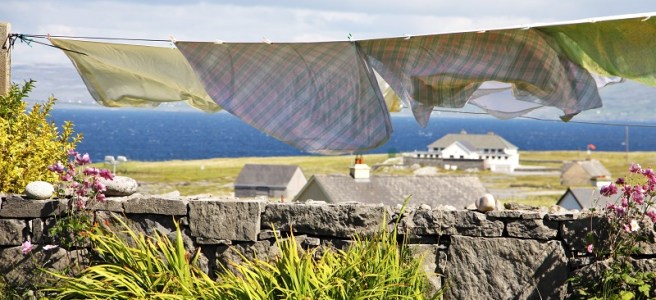
The three Aran Islands may be found at the mouth of Galway Bay, about 45 kilometers (km) from the city of Galway. They arrange themselves in a nice little diagonal line, with the biggest island located the furthest from the mainland and the smallest island located the closest to it. They are called Inis Mor (meaning “great island”), Inis Meain (meaning “middle island”), and Inis Oirr (meaning “east island”), and they are about 8 kilometers, 4 kilometers, and 2 kilometers from the coast to coast, respectively. Their names are quite unoriginal. All are distinguished by desolate karst scenery, including gray rocky plains that rise abruptly out of the water, green fields that are separated by stone walls, and whitewashed houses with thatched roofs. There is a close connection between the geology of the islands and that of The Burren in county Clare, which was created around 350 million years ago. The climate is similar to that of the rest of Ireland in that it is rainy and windy, although temperatures are seldom extreme either way. Agriculture was formerly the most important sector on the islands, but in modern times, tourism has surpassed it as the primary economic driver. In point of fact, the islands are home to a wide variety of plant and animal life. The islands can only be reached by boat, and there are almost any automobiles on the islands; instead, the most prevalent modes of transportation are bicycles, horse-drawn carriages, and minibusses used for guided excursions. Any vehicle is required to maintain a speed that does not exceed 50 kilometers per hour.
The biggest human settlement may be found on Inis Mor, which is home to a vibrant community of 840 permanent people and also receives the highest number of tourists each year. Kilronan is the primary settlement in the area, and it is here that a number of bed and breakfasts and other services can be found. With just 160 people calling Inis Meain home, it is true that this island has the lowest population, despite the fact that it is not the smallest island. It is home to a number of significant archaeological sites that are comparable to those found on Inis Mor. The population of the smallest island, Inis Oirr, is just approximately 300 people, yet it still manages to pack in a number of fascinating attractions, such as a historic monastery complex, a lighthouse, and a shipwreck! In addition to this, Caomhan of Inisheer is considered to be the town’s patron saint, and a church in the area is dedicated to him.
The Aran Islands have been devoid of human habitation for many thousand years, which has allowed the islands’ one-of-a-kind nature to develop without being disrupted. There is not much information available concerning the earliest people to settle on the islands, but it is possible that they came here in quest of rich land to cultivate or a source of fish to subsist off of. To our good fortune, the terrain was well suited for both of these uses; the sections of the land that were tallest and most rocky faced the ocean, protecting the low-lying areas that contained rich soil. In addition, the islands would have been mostly covered with woods, which the inhabitants cleared for use as fuel and materials for construction. Unfortunately, as a result of this, the soil was left without an anchor to help it remain in place, and as a result, fast erosion ensued. Since that time, in-depth examination of the soil has shown that the early islanders’ response to the issue was to incorporate seaweed, sand, and animal excrement into the soil, and then meticulously tend to it in order to guarantee that their food supply would not disappear. After exhausting their supply of wood, the islanders began transporting peat from the mainland to use as a substitute fire source.
The fact that these early Celtic islanders built monumental stone forts at the islands’ most strategic points despite being cut off from the mainland demonstrates that they recognized the importance of defending their territory from incursions by people from other areas. Their primary occupations consisted of fishing and farming. Later, when Christianity was introduced to Ireland, its influence quickly extended to the islands as well. After the construction of many churches and monastic sites, these locations took on the role of a kind of retreat for clerics in training; some of them remained there for years at a time while they prepared for their vocation as religious leaders, and others remained there permanently. For the next many centuries, life continued on in its tranquil and unchanging manner until the late 17th century, when Oliver Cromwell and his army appeared on the scene. After making landfall on Inis Mor, they immediately set about pillaging the forts and churches there before constructing their very own fortress at Castle Arkin. However, they did not remain there for very long since they found the terrain and the absence of contemporary civilization to be unpleasant. After then, a trickle of individuals continued to settle on the islands, eventually reaching a high of around 2,500 people until the Famine devastated the primary staple crop. Those islanders who had managed to live on the islands did so nearly entirely by subsisting on fish, and life was generally challenging for a number of decades until the government started providing monies for the islands’ economic growth. In the 21st century, the island is primarily a tourist attraction, and its inhabitants are proud to maintain their traditions and history while simultaneously participating in contemporary Irish society.
Monuments located on the Aran Islands
The Aran Islands are home to a number of Ireland’s most significant and ancient archaeological monuments. To begin, there is a network of stone walls going back to ancient times that runs over all three islands and totals 1600 kilometers in length. This would have been used for the purpose of containing animals and, in certain instances, may have been used to demarcate the borders of the territory. Clochans, also known as beehive huts, dates back to the early Christian era and may be seen perched on the brink of cliffs. Monks would utilize these structures for contemplation and thinking. Enda of Aran, a warrior king from Ulster, is credited with constructing the very first monastery on Inis Mor. At one point in time, there were up to a dozen monasteries erected on Inis Mor alone.
Dun Aonghusa
The most important archaeological site is Dun Aonghusa, which dominates the landscape of Inis Mor by perching on the edge of the island’s tallest rock and providing breathtaking vistas of the mainland below. This huge fort comprises 14 acres and is separated into outer, middle, and inner enclosures by curving walls that run right up to the cliff face. Excavation has uncovered considerable evidence of human activity going back more than 2,500 years. The fort is organized into three distinct sections. Additionally, closely spaced pillars served as a defense mechanism for the central enclosure. On the other side of the island, there is an ancient fort known as the Black Fort. It is believed that this fort served as the principal bastion prior to the construction of Dun Aonghusa. Both Teaghlach Einne, also known as St. Enda’s house, and Na Seacht dTeampaill, also known as the Seven Churches, are located on Inis Mor. Teaghlach Einne is a small church and graveyard that dates back 1500 years and is still used as the island’s main burial ground. Na Seacht dTeampaill is an ancient monastic site that remains the finest example of such a settlement.
The two smaller islands also have their fair share of attractions, particularly the Fort of Conchobar on Inis Meain, which is located on the larger of the two islands. This stronghold, which is in the form of an oval and located at a high height, provides breathtaking views of the mainland as well as all three of the surrounding islands. John Millington Synge, a famous Irish author, paid Inis Meain a visit in 1898 and immediately fell in love with the island. He proceeded to spend the next four summers in a beautiful little home on the island. It was thought that he got his inspiration for some of his best works, such as “The Playboy of the Western World” and “Riders to the Sea,” from the islands. The cottage where he stayed has undergone extensive renovations and is now available to the general public. It is known as “Cathoair Synge,” which literally translates to “Synge’s Chair,” and it is situated on the island with a view of both Inis Mor and the Atlantic Ocean.
Culture and customs unique to the Aran Island
Because of their remote location off the coast of an island at the very edge of Europe, the Aran Islands are naturally detached from the rest of the world. As a result, they have preserved distinctive and one-of-a-kind traditions of the Aran Islands and ways of life over the course of several centuries, in addition to the traditional culture and heritage of Ireland. The native language of the islands was Gaelic for many centuries, and this area is still considered to be part of the Gaeltacht today. The people who live there now are all bilingual speakers who are able to communicate in English and Irish fluently. When they are chatting with one another, they use Irish, but when they are talking with outsiders, they use English. Senior citizens who had lived on the islands their whole lives were unable (or, in some instances, unwilling) to acquire even a single word of English until the very end of the 20th century.
The principal employment of the indigenous people who lived on Aran Island beginning in the 17th century was farming. The wool and yarn from the cattle were used to manufacture clothes for the locals, who adopted a particular style of attire; handwoven trousers, skirts, coats, sweaters, shawls, hats, and even shoes were some of the items that were made by hand. In accordance with tradition, the ladies donned red skirts with black shawls. Pampooties were a kind of moccasin worn by men, coupled with the flat hats that are still often seen in rural regions. Men also wore colorful woven belts. The majority of people living on the islands currently dress in a contemporary style, although traditional garb is still sometimes worn for important events.
The use of the currach was yet another major custom that was only practiced in the Aran Islands. In bygone eras, the ocean was an inherent part of existence, and traveling across it was often fraught with danger. Currachs are the indigenous people’s unique boats that they created and constructed in order to navigate the treacherous waters of the Atlantic Ocean. It is a timber frame in the form of a canoe with animal skins spread over it, and a distinctive habit of the islands was to utilize a sail, which was not popular among currach users elsewhere in Ireland. The currach itself is in the shape of a canoe. Some fisherman on the islands continue to make full-time use of currachs, and currach racing is also a popular pastime during the summer and other times of the year when the weather is quite calm.
The Aran Sweater is perhaps the most well-known product associated with living on the Aran Islands. They were knitted from sheep’s wool and fishermen and farmers on the island wore them due to the inherent heat retention and water resistance capabilities of the wool. Aran sweaters are easily recognizable not just due to the thick and sometimes untreated wool that is used, but also due to the one-of-a-kind textured patterns that are utilized in knitting. Typically, the back and front of the sweater would be a reflection of one another, and the patterns would be interlaced in columns all the way down the length of the garment. If you believe the rumors, each family has its very own distinctive pattern, which has been handed down through the years and has significant meanings associated with various possible combinations of stitches of the Aran sweater. Regardless, knitting an Aran sweater requires a tremendous amount of talent, with some jumpers requiring up to 60 days and 100,000 stitches to finish an Aran sweater.
The cable stitch conjures up images of ropes used by fishermen and stands as a metaphor for a successful day at sea.
The diamond stitch is ideal for the smaller fields found on the islands and for a full day of labor in the field.
The honeycomb stitch is said to improve one’s chances of making a successful catch at sea and one’s overall fortune.
The Tree of Life stitch illustrates the progression through life or a certain path through one’s lifetime
Although there is no evidence to support this claim, there is a widespread myth that men who perished at sea were identified by the distinctive stitches that were worked into Aran sweaters. This was apparently not an extremely uncommon event in the past. Regardless of the significance or motivation behind these elaborate sweaters, they continue to enjoy a high level of popularity in modern times. Although they are now exported to a variety of countries, local island women are the ones who are responsible for knitting Aran sweaters.
Aran Jewelry Collection is a Symbol of Irish heritage.
The Aran sweater inspired the Aran Jewelry Collection as a symbol of Irish heritage and traditional Irish customs. Our Aran Irish jewelry collection is inspired by the Aran sweater weaving traditions and spinning tales connecting families for generations. Browse Aran Jewelry designs Inspired by the Aran Sweater & Islands.
The Aran Knit takes its name from the set of islands where it originated many generations ago, off the West coast of Ireland. The Aran Islands are at the mouth of Galway Bayin the Atlantic Sea. The home of fishermen and farmers the Aran Sweater was from a seafaring heritage, passed down from generation to generation, and is an important symbol of Irish family heritage.
The Aran Islands are one of the few sites in Ireland that have stayed largely unaltered over the course of centuries. They are located in the Atlantic Ocean off the coast of county Galway and are surrounded by the roaring waves of the Atlantic Ocean. These three little islands are a symbol of nearly everything having to do with Irish ancestry, culture, and tradition. In addition, they have their own distinctive practices and ways of living as well. Every summer, boatloads of tourists and day-trippers travel to get a taste of unspoiled Ireland, and they are immediately taken by the stark beauty of the landscape they find there. The Aran Islands are a fantastic destination for a day trip from the mainland or, if you really want to get away from it all, for a weekend stay on the islands themselves, regardless of whether you are a traveler from the other side of the ocean or from another part of Ireland. Regardless of what you decide to do, you will always find the history of the location to be fascinating.
Where are the Aran Islands Located?
The three Aran Islands may be found at the mouth of Galway Bay, about 45 kilometers (km) from the city of Galway. They arrange themselves in a nice little diagonal line, with the biggest island located the furthest from the mainland and the smallest island located the closest to it. They are called Inis Mor (meaning “great island”), Inis Meain (meaning “middle island”), and Inis Oirr (meaning “east island”), and they are about 8 kilometers, 4 kilometers, and 2 kilometers from the coast to coast, respectively. Their names are quite unoriginal. All are distinguished by desolate karst scenery, including gray rocky plains that rise abruptly out of the water, green fields that are separated by stone walls, and whitewashed houses with thatched roofs. There is a close connection between the geology of the islands and that of The Burren in county Clare, which was created around 350 million years ago. The climate is similar to that of the rest of Ireland in that it is rainy and windy, although temperatures are seldom extreme either way. Agriculture was formerly the most important sector on the islands, but in modern times, tourism has surpassed it as the primary economic driver. In point of fact, the islands are home to a wide variety of plant and animal life. The islands can only be reached by boat, and there are almost any automobiles on the islands; instead, the most prevalent modes of transportation are bicycles, horse-drawn carriages, and minibusses used for guided excursions. Any vehicle is required to maintain a speed that does not exceed 50 kilometers per hour.
The biggest human settlement may be found on Inis Mor, which is home to a vibrant community of 840 permanent people and also receives the highest number of tourists each year. Kilronan is the primary settlement in the area, and it is here that a number of bed and breakfasts and other services can be found. With just 160 people calling Inis Meain home, it is true that this island has the lowest population, despite the fact that it is not the smallest island. It is home to a number of significant archaeological sites that are comparable to those found on Inis Mor. The population of the smallest island, Inis Oirr, is just approximately 300 people, yet it still manages to pack in a number of fascinating attractions, such as a historic monastery complex, a lighthouse, and a shipwreck! In addition to this, Caomhan of Inisheer is considered to be the town’s patron saint, and a church in the area is dedicated to him.
The Aran Islands have been devoid of human habitation for many thousand years, which has allowed the islands’ one-of-a-kind nature to develop without being disrupted. There is not much information available concerning the earliest people to settle on the islands, but it is possible that they came here in quest of rich land to cultivate or a source of fish to subsist off of. To our good fortune, the terrain was well suited for both of these uses; the sections of the land that were tallest and most rocky faced the ocean, protecting the low-lying areas that contained rich soil. In addition, the islands would have been mostly covered with woods, which the inhabitants cleared for use as fuel and materials for construction. Unfortunately, as a result of this, the soil was left without an anchor to help it remain in place, and as a result, fast erosion ensued. Since that time, in-depth examination of the soil has shown that the early islanders’ response to the issue was to incorporate seaweed, sand, and animal excrement into the soil, and then meticulously tend to it in order to guarantee that their food supply would not disappear. After exhausting their supply of wood, the islanders began transporting peat from the mainland to use as a substitute fire source.
The fact that these early Celtic islanders built monumental stone forts at the islands’ most strategic points despite being cut off from the mainland demonstrates that they recognized the importance of defending their territory from incursions by people from other areas. Their primary occupations consisted of fishing and farming. Later, when Christianity was introduced to Ireland, its influence quickly extended to the islands as well. After the construction of many churches and monastic sites, these locations took on the role of a kind of retreat for clerics in training; some of them remained there for years at a time while they prepared for their vocation as religious leaders, and others remained there permanently. For the next many centuries, life continued on in its tranquil and unchanging manner until the late 17th century, when Oliver Cromwell and his army appeared on the scene. After making landfall on Inis Mor, they immediately set about pillaging the forts and churches there before constructing their very own fortress at Castle Arkin. However, they did not remain there for very long since they found the terrain and the absence of contemporary civilization to be unpleasant. After then, a trickle of individuals continued to settle on the islands, eventually reaching a high of around 2,500 people until the Famine devastated the primary staple crop. Those islanders who had managed to live on the islands did so nearly entirely by subsisting on fish, and life was generally challenging for a number of decades until the government started providing monies for the islands’ economic growth. In the 21st century, the island is primarily a tourist attraction, and its inhabitants are proud to maintain their traditions and history while simultaneously participating in contemporary Irish society.
Monuments located on the Aran Islands
The Aran Islands are home to a number of Ireland’s most significant and ancient archaeological monuments. To begin, there is a network of stone walls going back to ancient times that runs over all three islands and totals 1600 kilometers in length. This would have been used for the purpose of containing animals and, in certain instances, may have been used to demarcate the borders of the territory. Clochans, also known as beehive huts, dates back to the early Christian era and may be seen perched on the brink of cliffs. Monks would utilize these structures for contemplation and thinking. Enda of Aran, a warrior king from Ulster, is credited with constructing the very first monastery on Inis Mor. At one point in time, there were up to a dozen monasteries erected on Inis Mor alone.
Dun Aonghusa
The most important archaeological site is Dun Aonghusa, which dominates the landscape of Inis Mor by perching on the edge of the island’s tallest rock and providing breathtaking vistas of the mainland below. This huge fort comprises 14 acres and is separated into outer, middle, and inner enclosures by curving walls that run right up to the cliff face. Excavation has uncovered considerable evidence of human activity going back more than 2,500 years. The fort is organized into three distinct sections. Additionally, closely spaced pillars served as a defense mechanism for the central enclosure. On the other side of the island, there is an ancient fort known as the Black Fort. It is believed that this fort served as the principal bastion prior to the construction of Dun Aonghusa. Both Teaghlach Einne, also known as St. Enda’s house, and Na Seacht dTeampaill, also known as the Seven Churches, are located on Inis Mor. Teaghlach Einne is a small church and graveyard that dates back 1500 years and is still used as the island’s main burial ground. Na Seacht dTeampaill is an ancient monastic site that remains the finest example of such a settlement.
The two smaller islands also have their fair share of attractions, particularly the Fort of Conchobar on Inis Meain, which is located on the larger of the two islands. This stronghold, which is in the form of an oval and located at a high height, provides breathtaking views of the mainland as well as all three of the surrounding islands. John Millington Synge, a famous Irish author, paid Inis Meain a visit in 1898 and immediately fell in love with the island. He proceeded to spend the next four summers in a beautiful little home on the island. It was thought that he got his inspiration for some of his best works, such as “The Playboy of the Western World” and “Riders to the Sea,” from the islands. The cottage where he stayed has undergone extensive renovations and is now available to the general public. It is known as “Cathoair Synge,” which literally translates to “Synge’s Chair,” and it is situated on the island with a view of both Inis Mor and the Atlantic Ocean.
Culture and customs unique to the Aran Island
Because of their remote location off the coast of an island at the very edge of Europe, the Aran Islands are naturally detached from the rest of the world. As a result, they have preserved distinctive and one-of-a-kind traditions of the Aran Islands and ways of life over the course of several centuries, in addition to the traditional culture and heritage of Ireland. The native language of the islands was Gaelic for many centuries, and this area is still considered to be part of the Gaeltacht today. The people who live there now are all bilingual speakers who are able to communicate in English and Irish fluently. When they are chatting with one another, they use Irish, but when they are talking with outsiders, they use English. Senior citizens who had lived on the islands their whole lives were unable (or, in some instances, unwilling) to acquire even a single word of English until the very end of the 20th century.
The principal employment of the indigenous people who lived on Aran Island beginning in the 17th century was farming. The wool and yarn from the cattle were used to manufacture clothes for the locals, who adopted a particular style of attire; handwoven trousers, skirts, coats, sweaters, shawls, hats, and even shoes were some of the items that were made by hand. In accordance with tradition, the ladies donned red skirts with black shawls. Pampooties were a kind of moccasin worn by men, coupled with the flat hats that are still often seen in rural regions. Men also wore colorful woven belts. The majority of people living on the islands currently dress in a contemporary style, although traditional garb is still sometimes worn for important events.
The use of the currach was yet another major custom that was only practiced in the Aran Islands. In bygone eras, the ocean was an inherent part of existence, and traveling across it was often fraught with danger. Currachs are the indigenous people’s unique boats that they created and constructed in order to navigate the treacherous waters of the Atlantic Ocean. It is a timber frame in the form of a canoe with animal skins spread over it, and a distinctive habit of the islands was to utilize a sail, which was not popular among currach users elsewhere in Ireland. The currach itself is in the shape of a canoe. Some fisherman on the islands continue to make full-time use of currachs, and currach racing is also a popular pastime during the summer and other times of the year when the weather is quite calm.
The Aran Sweater is perhaps the most well-known product associated with living on the Aran Islands. They were knitted from sheep’s wool and fishermen and farmers on the island wore them due to the inherent heat retention and water resistance capabilities of the wool. Aran sweaters are easily recognizable not just due to the thick and sometimes untreated wool that is used, but also due to the one-of-a-kind textured patterns that are utilized in knitting. Typically, the back and front of the sweater would be a reflection of one another, and the patterns would be interlaced in columns all the way down the length of the garment. If you believe the rumors, each family has its very own distinctive pattern, which has been handed down through the years and has significant meanings associated with various possible combinations of stitches of the Aran sweater. Regardless, knitting an Aran sweater requires a tremendous amount of talent, with some jumpers requiring up to 60 days and 100,000 stitches to finish an Aran sweater.
The cable stitch conjures up images of ropes used by fishermen and stands as a metaphor for a successful day at sea.
The diamond stitch is ideal for the smaller fields found on the islands and for a full day of labor in the field.
The honeycomb stitch is said to improve one’s chances of making a successful catch at sea and one’s overall fortune.
The Tree of Life stitch illustrates the progression through life or a certain path through one’s lifetime
Although there is no evidence to support this claim, there is a widespread myth that men who perished at sea were identified by the distinctive stitches that were worked into Aran sweaters. This was apparently not an extremely uncommon event in the past. Regardless of the significance or motivation behind these elaborate sweaters, they continue to enjoy a high level of popularity in modern times. Although they are now exported to a variety of countries, local island women are the ones who are responsible for knitting Aran sweaters.
Aran Jewelry Collection is a Symbol of Irish heritage.
The Aran sweater inspired the Aran Jewelry Collection as a symbol of Irish heritage and traditional Irish customs. Our Aran Irish jewelry collection is inspired by the Aran sweater weaving traditions and spinning tales connecting families for generations. Browse Aran Jewelry designs Inspired by the Aran Sweater & Islands.
The Aran Knit takes its name from the set of islands where it originated many generations ago, off the West coast of Ireland. The Aran Islands are at the mouth of Galway Bayin the Atlantic Sea. The home of fishermen and farmers the Aran Sweater was from a seafaring heritage, passed down from generation to generation, and is an important symbol of Irish family heritage.
Ogham is a timeless and ancient alphabet. The term Ogham is derived from the word Ogma, which refers to the Celtic God of Elocution or eloquence. The Ogham alphabet consists of groups of one to five lines arranged vertically over a stem line, with each group representing a distinct letter.
The history of the beautiful, enchanting, and mythological Ogham alphabet is obscured by the mists of time. The Ogham script is the earliest written alphabet in Ireland, and its origin is still the subject of considerable conjecture.
Some experts date Ogham to the first century AD, while others place its origins in the fourth century. It is believed that the Ogham alphabet originated in southwest Ireland, likely in Cork or Kerry, but this enigmatic script prefers to preserve secrets!
Researchers can only state with certainty that it is an ancient alphabet that was widely used from the fourth to ninth centuries, mostly for ceremonial inscriptions. With our exquisite collection of Ogham jewelry, it is now able to share this illustrious past.
When did Ogham become obsolete?
Ogham is an alphabet found on monumental inscriptions from the fourth to sixth centuries AD and in manuscripts from the sixth to ninth centuries AD. Primitive and Old Irish were its primary uses, along with Old Welsh, Pictish, and Latin.
What is the number of Ogham stones in Ireland?
There are now about 400 ogham stones in existence, with the majority (roughly 360) located in Ireland. The biggest densities may be found in the southwest, namely in Kerry, Cork, and Waterford.
Is Ogham a Celtic language?
According to the High Medieval Bratharogam, distinct letters correspond to the names of different trees. Because of this, ogham is frequently referred to as the Celtic tree alphabet.
How does the Ogham script appear?
This ancient script is an alphabet consisting of a single horizontal line and a succession of vertical and diagonal lines for each letter. The lines symbolize several historic Irish letters. Today, around 400 instances of Ogham stones may still be discovered in Ireland and West Wales.
Did Druids use Ogham?
It is said that Ogham was founded by Gaulish Druids in Cisalpine Gaul circa 600 BCE as a hand signal and vocal language.
Is Ogham read from lowest to highest?
Every character is composed of many slashes. These would be read from bottom to top along the center line. Each letter is mostly found in Ireland and Western Wales and is related to a tree or plant. It is thought that the majority of Ogham was written in Old Irish.
Ancient Ogham Alphabet
About the Ancient Ogham Alphabet
In regards to the Ogham Alphabet, minimalism is beautiful. Reading from bottom to top, the alphabet is phonetic and is distinguished by each letter being represented by a succession of markings along a central vertical line.
Numerous myths are related to the enigma surrounding the alphabet. From legends of Celtic Gods to a secret code designed to confound neighboring British tribes, or simply as a means of converting Gaelic sounds into Latin letters, the reality surrounding the individuals who invented the alphabet remains as obscure as ever.
It is simple to see why Ogham is often known as the “Celtic Tree Alphabet.” The vertical line represents the tree’s trunk, while the vertical lines represent its branches. The outcome is a mysterious and ancient beauty that transcends conjecture.
Our Ogham jewelry collection incorporates all of these elements, merging myth, history, legacy, and beauty in a spectacular selection of bespoke pieces.
Recognizing the Ogham Letters
The Ogham Alphabet consists of twenty symbols, some of which are immediately transliterated into letters and others of which are more closely related to sounds. With these twenty characters, any name may be translated into Ogham.
When transliterating your name, the distinctions between the Ogham and Latin alphabets are essential. Numerous of these distinctions indicate that if you have an English name, it is preferable to choose its Irish counterpart.
This is shown by the fact that the letter J in Ogham is identical to the letter S. Considering that Sean is the Irish counterpart of John, this makes a bit more sense.
Other distinctions include:
The letter U is replaced with the letter W.
The letter K is replaced with the letter X.
The letter Y replaces the letter I (i)
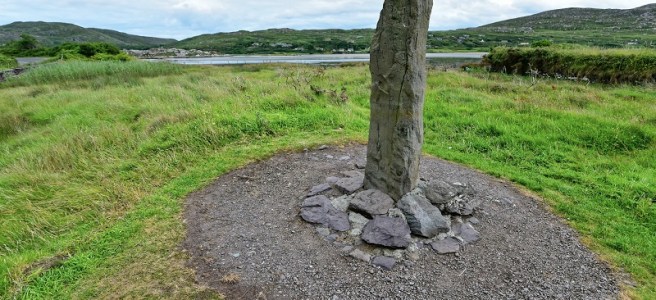
Pillar stone from Killeen Cormac, Colbinstown, County Kildare, containing Ogham Script and Roman capitals. Early to mid-7th century A.D.
This is one of two Ogham stones on display at the National Museum of Ireland on Kildare Street in Dublin. Our store is merely a two-minute walk away. The museum is not enormous, yet it is beautiful. The National Museum is a highly rated and free attraction in Dublin.
A Part of the Past for All Occasions
We think each item of jewelry should possess its own unique enchantment. Our selection of Ogham jewelry includes this and much more. Shop The Irish Jewelry Company to learn more about our selection of mystical and exquisite Ogham jewelry.
The concept of a “fairy king” is quite prevalent in the folklore of both the United Kingdom and Ireland. In a fairy kingdom, these Fairy Kings and Fairy Queens exercise as much control over their subjects as is humanly feasible over a small number of people. There are literary versions of certain fairy monarchs, versions that are part of Celtic folklore, and versions that are either historical individuals or gods. According to an old rule, the names Fairy King and Fairy Queen are still used to refer to this royal couple in Scotland.
How to Call Upon a King of the Fairies
There’s a classic Irish melody called “King of the Fairies,” which you may be acquainted with. Both the Dubliners and the Irish Rovers have played more up-to-date renditions of the song in their live shows. It is now thought that the song originated from a Jacobite melody from the 18th century called “Bonny Charlie.” This tune hailed the rebellious Scottish prince at the time it was written. There is a rendition of the song performed in Britain that is referred to as “King William of Orange.”
According to local legend, singing this song is the only way to call upon the Fairy King. It is required that the Fairy King make an appearance if you play it three times in a row while hosting a party. If he enjoys himself at the party, he will remain there and participate in the activities. Expect him to stir some trouble if he feels the gathering is uninteresting.
So what were the names of the various fairy kings?
Let’s have a look at the many candidates for the role of “King of the Fairies,” since there are plenty of them:
Fairy King of Leinster
Ailill was a Milesian Fairy King of Leinster, according to Irish tradition; yet, he could also stake a claim to the throne of Connacht owing to the fact that his mother was from a noble Connacht family. Ailill wed Medbh, the queen of Ireland, and as a condition of the marriage, she was required to pay a massive dowry. It consisted of twenty-one enslaved people, an amount of money equal to the weight of his shield arm, a dozen men’s suits of clothes, and a wedding ring made of red gold that was as big as his face. His complexion is described as being ruddy, and he wears a golden diadem on his head. He is said to be extraordinarily tall.
Who Was Finvarra
Alternately written as “Fin Bheara” and “Finnbhear,” According to Irish tradition, Finvarra reigned over Connacht as the King of the Fairies and over the Daoine Sidhe as King of the Daoine Sidhe. In several of the stories that have been passed down, he is also referred to as the King of the Dead. Finvarra and his spouse Oona settled in Knockmaa, County Galway. Finvarra had a weakness for attractive mortal women and was married to Oona.
Once the Milesians came to Ireland, the majority of the Tuatha De Danann were forced to escape, but Finvarra chose to stay behind and lead the Daoine Sidhe, which is the name given to the surviving members of the tribe. Legend has it that Finvarra arranged a peace with the Milesians that permitted him and his people to stay in Ireland so long as they promised to live underground. This allowed Finvarra and his people to remain in Ireland. They started to have an influence on the people who lived above the earth when the monarch directed the construction of several large towns. In the end, it would be impossible for a human to construct anything without first receiving permission from the fairy king.
Iubdan Fairy King of Ulster
The Fairy King of Ulster is said to have a little height, and he is notorious for bragging about his accomplishments to an exaggerated degree. Iubdan was the chief of a tribe called the Faylinn, who was also known as the Wee Folk and were said to have only been a few inches tall. Bebo was the name of the Fairy Queen, and due to the fact that Faylinn was so little, they were under the impression that giants made up the majority of Ireland’s human population.
Iubdan had a pattern of bragging about how magnificent he was, so the poet of the court eventually became fed up with his behavior and shared a story with the royal pair about Ulster, the realm of giants, and the porridge they ate. Iubdan, who was haughty and eager to display his superiority to Fergus mac Leda, King of Ulster, made the decision to journey north in order to accomplish this goal.
His plan was to stealthily enter the giant’s lair and consume some of the giant’s porridge without being discovered. After falling into the enormous bowl of porridge, the stupid Fairy King and his Queen found themselves in a hopeless situation. Fergus, who was imprisoned as a prisoner by the Giants, was given the couple to interrogate. After some time, he agreed to free them in return for the fairy king’s most valued item, a pair of enchanted shoes that gave the owner the ability to walk on water. One can’t help but wonder whether Jonathan Swift was inspired by the Faylinn in Gulliver’s Travels when he created the kingdom of Lilliput and its pompous residents.
Midhir son of the Dagda
This Fairy King, whose name may also be written as “Midhir,” was the son of the Dagda and is a significant character in the Mythological Cycle of early Irish literature. He was said to have ruled Ireland. Midhir made his home in the sidh of Bri Leith, which is now known as Ardagh Hill and is located in County Longford. This was after the Tuatha de Danann were driven underground by the Milesians. It’s possible that the name comes from the Irish term for judge, which is midithir.
Fuamnach was Midhir’s wife, but he divorced her and married Etain after falling in love with her. Because Fuamnach was so envious of Etain, she transformed her into a fly and chased her away from the magical hills of Ireland.
Poor Etain was carried all across the land for seven years before being ultimately transported back and landing in Fuamnach’s wine cup! The poor fly was eaten by the queen, but after spending the next nine months growing within the queen’s stomach, Etain was reborn as a lovely lady, matured, and eventually married the King of Munster, Eochaid.
When Midhir learned that his life’s love was somewhere in Munster, he immediately traveled there and issued a challenge to Eochaid to play three games of chess. He was unsuccessful in the first two games, but in the third and last one, he was victorious, and he demanded Etain as his reward. Although he was hesitant, Eochaid did consent to one kiss. On the other hand, Midhir and Etain managed to escape by flying away; they turned into two white swans connected by a golden chain. Eochaid and his soldiers gave chase to the two individuals until they reached the fairy hills in Ulster, where they dug into the ground there. In the end, Eochaid was successful in reclaiming his wife, but the authority of the Tuatha de Danann swiftly began to wane.





 irish culture and traditions